What's in My Camera Bag for Shooting Street Scenes in Brazil
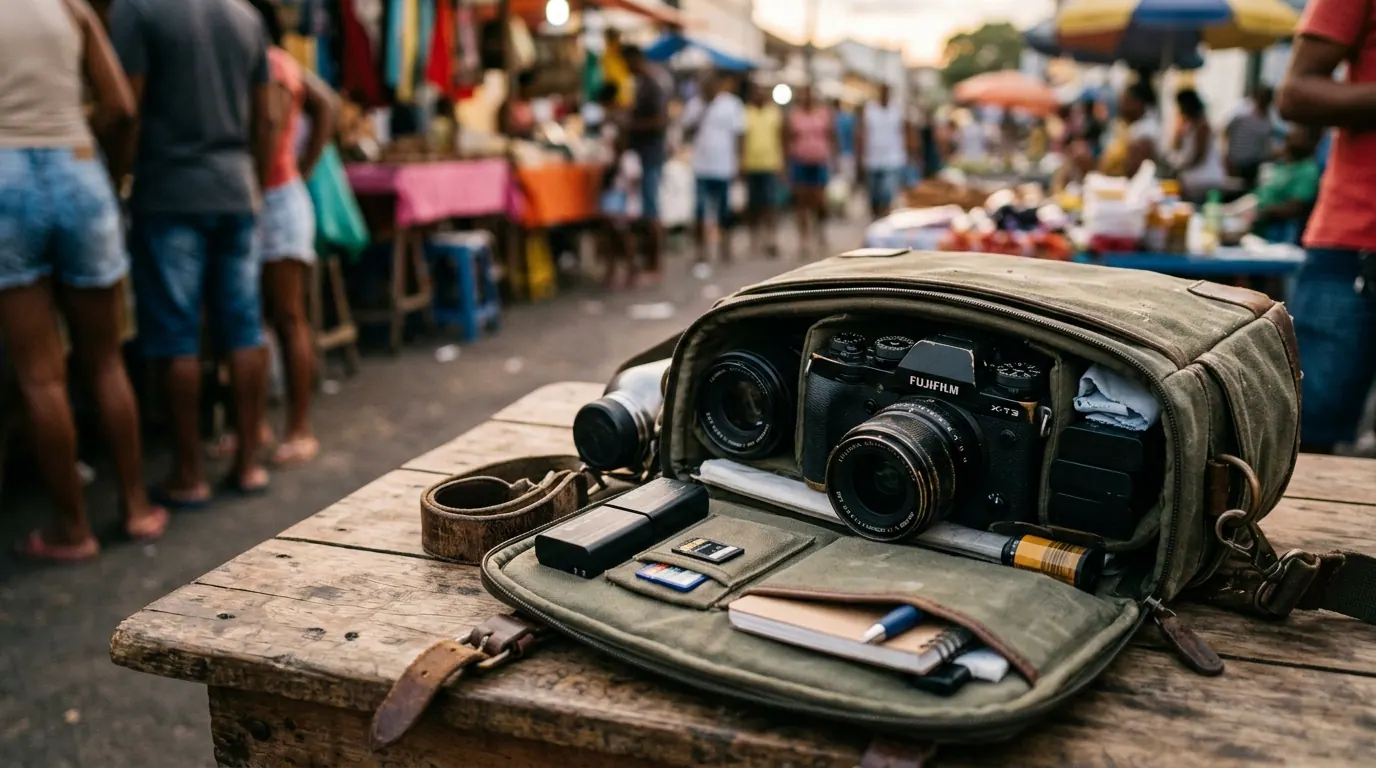
Generated (Gemini), via Wikimedia Commons
For three weeks shooting street scenes in Rio, Salvador, and São Paulo, I carried one camera body, two lenses, and a bag I could sling across my body and forget about. That was the whole kit. Everything else I packed either stayed in the hotel room or came out once and went back in the bag for good.
The short answer
One mirrorless body, a 35mm-equivalent prime, and a small zoom in the 24-70mm range, carried in a bag that closes with a zip, not a flap. That's the setup that got used every single day. The prime stayed on the camera most of the time because street work in Brazil moves fast. People notice a camera quickly, especially in busy markets or on crowded sidewalks, and you often get one or two frames before the moment passes or someone waves you off. A fixed lens you already know the angle of view for beats fumbling with a zoom ring while a scene closes up in front of you.
What changes the kit
A few things pushed me to adjust what I actually carried out the door each morning, and they'd probably do the same for anyone else.
- Which city. Rio's beach neighborhoods and Salvador's Pelourinho are dense with people and light changes fast under awnings and alleys, so I leaned on the prime. São Paulo's wider avenues and financial district gave more room to use the zoom without crowding anyone.
- Time of year. Carnaval season means bigger crowds, more bag-watching, and less patience for a stranger pointing a lens. Outside that window, especially weekday mornings, people are calmer and more willing to be photographed or just ignore you.
- How much walking. On days with six or seven hours on foot, weight mattered more than range. A second lens I didn't use often was dead weight by hour four.
- Neighborhood and time of day. In areas where locals or hotel staff suggested keeping a low profile, the whole kit shrank to just the camera and prime, no bag at all, camera on a wrist strap under a jacket between shots.
Signs your setup isn't working
A few things tell you pretty quickly that what you packed isn't matching how you're actually shooting.
- Your neck or shoulder is sore by early afternoon, which usually means the strap or the weight is wrong, not that you're out of shape.
- You keep missing shots because you're changing lenses or digging in a bag while the scene happens in front of you.
- People are reacting to the camera itself more than to being photographed, which often means it's too big, too loud, or you're holding it up too long before shooting.
- You're sweating through a bag strap or feeling gear get warm and damp in humidity, which in Rio and Salvador especially is a daily thing, not an occasional one.
- You keep leaving a lens or accessory in the room because you never touch it, which is really a sign to just stop carrying it.
What happens if you don't adjust
Carrying too much gear, or the wrong bag, has real costs on a trip like this. A backpack you have to swing around to open is slow and it also draws attention exactly when you don't want it, since it signals to anyone nearby that there's something worth grabbing. A shoulder bag with an open top or a flap closure is an easy target in a crowded market or on a packed bus, and losing a camera body or a laptop to a quick grab is not rare in dense tourist areas of Rio or São Paulo. That's not fear-mongering, it's just the same practical caution locals themselves usually mention, and it costs nothing to listen to.
Beyond theft risk, there's simple fatigue. Extra lenses, a second body, a tripod you never used, all of that adds up over a full day of walking, and tired shoulders make for lazier framing and fewer photos taken near the end of the day, which is often when the light and the street life are at their best. Humidity and sudden rain, especially in Salvador and Rio, can also damage gear that isn't in a closed bag, and equipment failure mid-trip with no easy repair option nearby is a bigger problem than most people plan for.
None of this means you need expensive gear. A used or older mirrorless body in good condition, paired with one or two lenses, is enough. What matters more is a bag that closes securely, a strap that doesn't hurt after four hours, and the discipline to leave at home anything you know you won't reach for more than once. I wrote this up for Window Seat World mainly because most gear lists for Brazil read like general travel photography advice with a few local photos dropped in, and the actual day-to-day answer is simpler and a little more boring than most lists suggest. Carry less, keep it closed, and know exactly where your hands go before you lift the camera.
New trip reports as they land
First-person routes, costs and photos from trips actually taken. Join the list.
Join the list