What I Got Wrong About Tipping in the US as a Brazilian Traveler
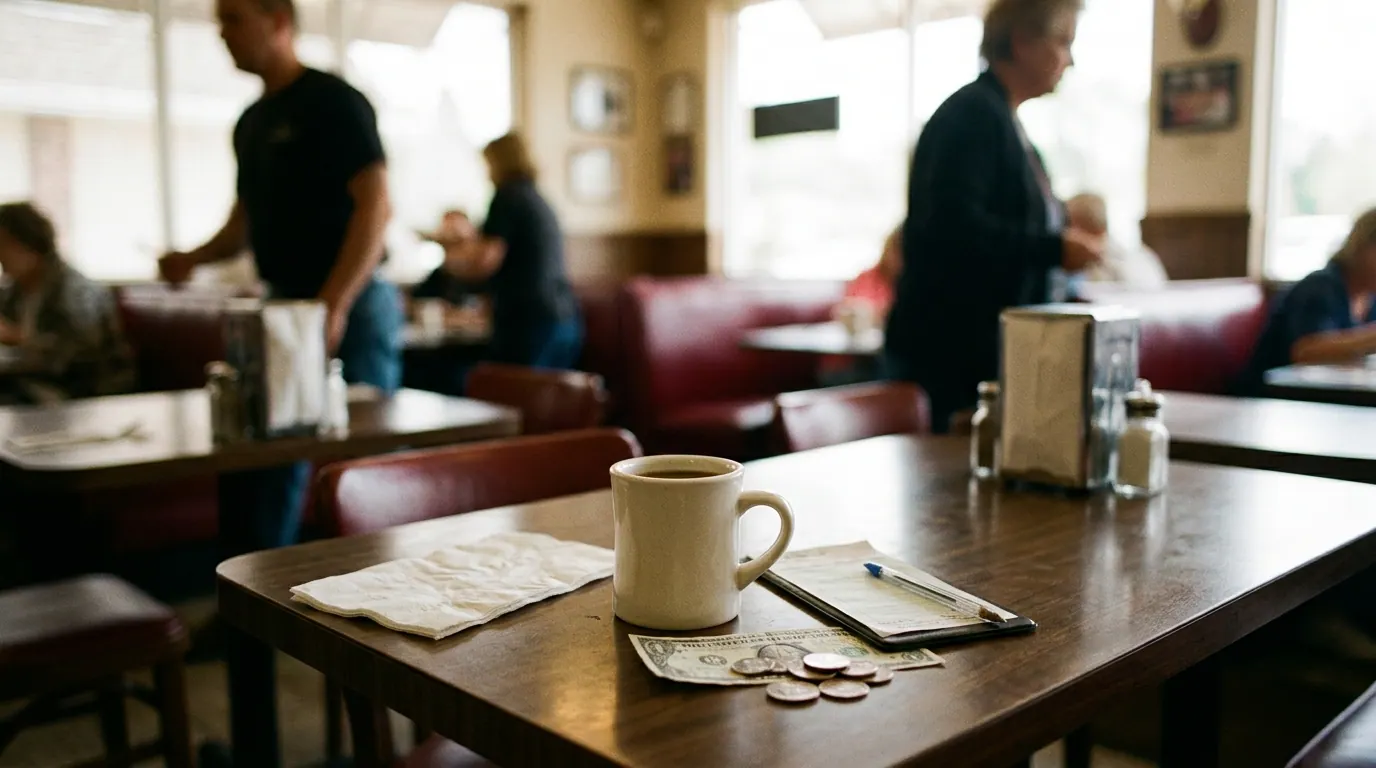
Generated (Gemini), via Wikimedia Commons
In the US you tip right at the end of the interaction, before you've even finished eating or before the person has walked away, and you decide the amount while the bill is still open in front of you, not after. That's the part nobody explained to me before my first trip. In Brazil the service charge is usually built in, so you just pay the bill and move on. In the US, the bill and the tip are two separate decisions, and you make the second one on the spot.
The short answer
The short answer
15% to 20% on restaurant meals, and some form of tip on almost any service where a person did something for you directly. That's the rough rule I wish someone had given me in plain terms before I landed. It's not a suggestion you can skip if the service was just okay. It's closer to a wage top-up that American service workers actually depend on, because in most states the base hourly pay for tipped roles is legally allowed to be much lower than minimum wage. Skipping it isn't like skipping a suggested donation. It's closer to shorting someone's paycheck.
What changes the timing
A few things move the moment and the amount around, and this is where I kept getting caught out.
- Counter service vs table service. At a coffee shop or fast-casual counter, tipping is optional and often small, maybe rounding up or a dollar or two. At a sit-down restaurant with a server, it's expected and larger.
- The card machine shows you the prompt before service is even finished. Plenty of places hand you a tablet with 18%, 20%, 25% buttons before you've picked up your coffee. That's not a fixed rule, it's just the software nudging you. You can always choose "no tip" or enter a custom amount, but the first time it happens, it feels like pressure, and it threw me off completely on day one.
- Group size. Many restaurants automatically add an 18% to 20% "gratuity" for tables of six or more. Check the bill before adding another tip on top, or you'll double up without meaning to.
- Region and venue. Tipping culture is stronger in cities and in sit-down dining, weaker in small-town counter service, and almost absent in some self-serve or fast-food settings. There's no single number that covers the whole country, and I had to recalibrate city by city.
Signs you are overdue (or getting it wrong)
These are the moments that told me I hadn't adjusted yet.
- The card machine gets turned around and handed back to you with a slightly longer pause than normal. That pause is the tip prompt, and if you tap "no tip" out of habit, you'll feel the temperature in the room change.
- You get no change back from a cash payment and the staff member just says thanks and walks off, assuming the difference was the tip. If you actually wanted change, you have to ask.
- You tip the same flat amount everywhere, like a coffee cart and a sit-down dinner, because it's easier to default to one number. It's not wrong exactly, but it tells you you're not reading the situation yet.
- You tip after seeing bad service only, rather than as the standard expectation. In the US, the tip is the default, and you lower it for bad service rather than only giving it for good service.
- Hotel housekeeping, which I genuinely didn't know was a thing until a concierge gently mentioned it. There's no hard number, but a few dollars per night left in the room is the general custom, and it's easy to miss entirely if nobody tells you.
What happens if you wait too long
Nothing dramatic happens on the spot, which is actually what makes it easy to keep getting wrong. Nobody in the US is going to chase you down and explain the tipping rules. What actually happens is smaller and slower. Servers remember who under-tips if you're a repeat customer at the same place during a longer stay. Bartenders pour lighter or slower for tables that clearly don't tip. Hotel staff notice which rooms never leave anything, and it doesn't change your stay dramatically, but it doesn't help it either. The real cost isn't a confrontation, it's a slightly worse version of the same trip, service that's technically fine but never quite warm.
There's also a quieter cost to yourself, which is the awkwardness. I spent the first few days of my first US trip doing mental math at every register, unsure if 10% was rude or if 25% was overkill, and that small background anxiety took up more attention than it should have. Once I settled on a working range, 18% to 20% at sit-down restaurants, a dollar or two at counters, a few dollars a day for hotel housekeeping, and nothing extra at places where it's clearly not the custom, the whole trip got easier to move through.
If I were explaining this to a friend heading to the US for the first time from Brazil, I'd say this: treat the tip as part of the price, not as a bonus you hand out for excellence. Decide your range before you sit down, not while the card machine is staring at you. That one shift fixed most of what I was getting wrong, and it's the kind of small, unglamorous detail Window Seat World tends to dig into, the stuff that doesn't show up in a packing list but changes how a trip actually feels.
New trip reports as they land
First-person routes, costs and photos from trips actually taken. Join the list.
Join the list